
When Dangerous Road Design Causes a Pedestrian or Bicycle Accident
Pedestrians and bicyclists depend on safe roadways to travel through neighborhoods, reach workplaces, visit businesses, attend school, and access public transportation. Unlike people inside passenger vehicles, pedestrians and cyclists have very little physical protection when a collision occurs. Even a relatively low-speed accident can result in broken bones, traumatic brain injuries, spinal cord damage, permanent disabilities, and other serious medical conditions.
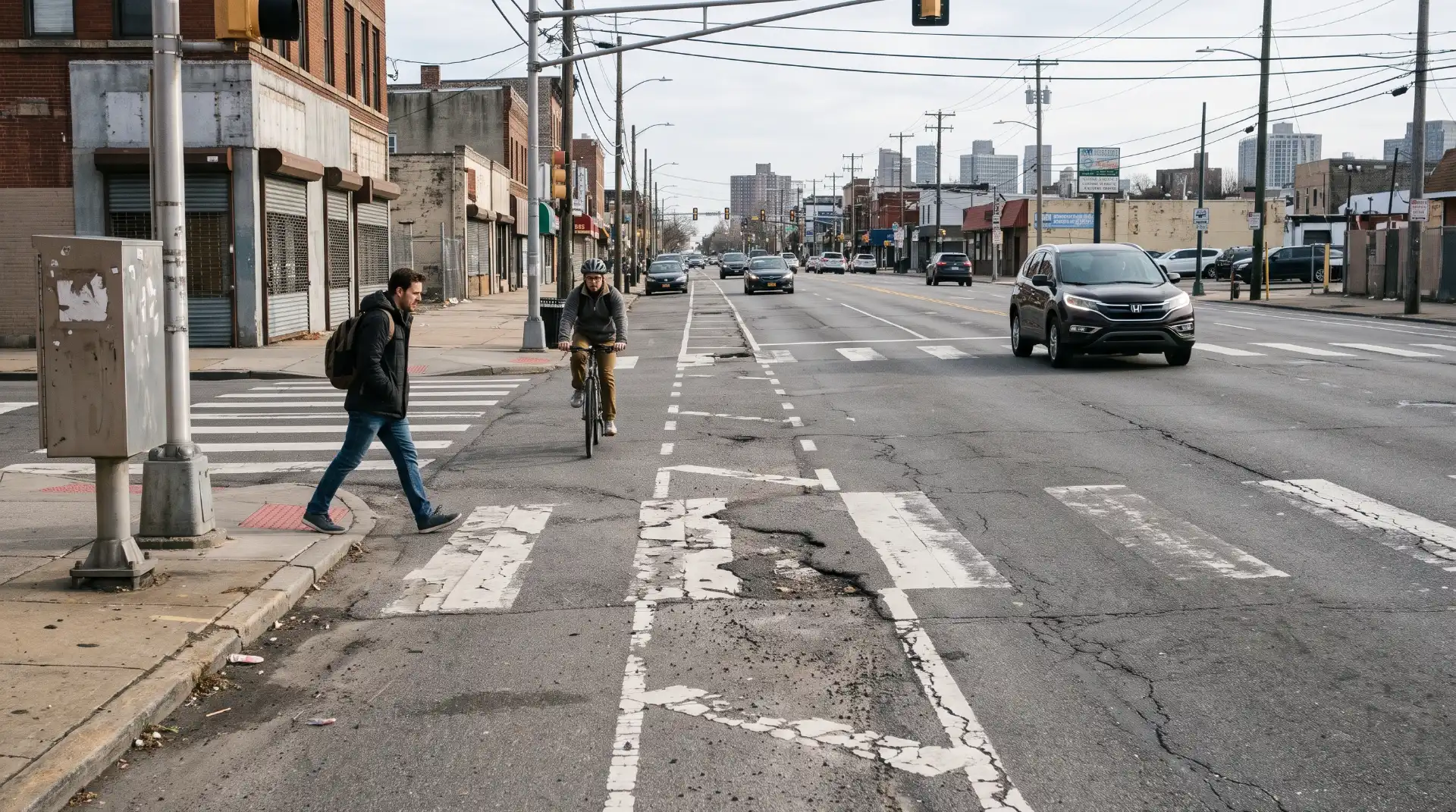
Although many pedestrian and bicycle accidents involve negligent drivers, not every collision is caused exclusively by a motorist. Sometimes, the roadway itself contributes to the accident. Poorly designed intersections, missing sidewalks, inadequate bicycle lanes, dangerous crosswalk placements, obstructed visibility, confusing traffic signals, and poorly maintained road surfaces can create conditions that expose pedestrians and cyclists to unnecessary danger.
Consider a pedestrian attempting to cross a wide roadway without a properly marked crosswalk or a cyclist traveling along a street where a designated bicycle lane suddenly disappears. A driver approaching the area may have limited visibility or insufficient space to react. If the pedestrian or cyclist is struck, the investigation should not necessarily stop with the driver’s conduct. It may also be important to determine whether the road’s design, construction, maintenance, or traffic-control system contributed to the collision.
In some circumstances, injured individuals may pursue compensation from a negligent driver, a government transportation agency, a private property owner, a construction contractor, an engineering company, or another responsible party. However, claims involving dangerous roadway conditions can be particularly complicated because government liability rules, special notice requirements, statutory immunities, and engineering standards may apply.
The central question is whether a legally responsible party failed to use the level of care required under the circumstances and whether that failure contributed to the accident and resulting injuries.
Understanding how unsafe road design contributes to pedestrian and bicycle accidents can help injured individuals recognize potential legal claims, preserve important evidence, and understand the compensation that may be available.
How Unsafe Road Design Contributes to Pedestrian and Bicycle Accidents
Roadway design affects how pedestrians, bicyclists, and motorists interact with one another. A street that prioritizes vehicle speed without providing adequate protection for vulnerable road users may create serious hazards, particularly in busy commercial districts, residential neighborhoods, school zones, and areas with heavy pedestrian activity.
A road does not necessarily have to contain an obvious structural defect to be dangerous. Sometimes, several smaller design problems combine to create an environment where an accident becomes more likely.
Intersections With Poor Visibility
Intersections are particularly dangerous because vehicles, pedestrians, and bicycles frequently approach from different directions. Drivers must identify pedestrians crossing the street, cyclists traveling through the intersection, and vehicles entering or turning across their paths.
Poor intersection design can interfere with visibility. Buildings, landscaping, utility equipment, parked vehicles, roadside signs, and improperly placed street furniture may block a driver’s view of someone crossing the road.
A cyclist traveling straight through an intersection may also be difficult for a turning driver to see, especially when the roadway has poorly positioned bicycle lanes or inadequate separation between traffic movements.
For example, a vehicle driver making a right turn may focus on approaching motor traffic without noticing a cyclist traveling beside the vehicle. If the intersection’s configuration creates a blind area or places the bicycle route directly within the turning vehicle’s path, the design may deserve investigation.
The existence of a visibility problem does not automatically establish legal liability. Investigators must determine whether the condition violated an applicable duty, whether the responsible party knew or should have known about the hazard, and whether the condition contributed to the accident.
Missing or Inadequate Sidewalks
Sidewalks provide pedestrians with a designated space separated from moving vehicles. When sidewalks are missing, disconnected, excessively narrow, or blocked by permanent obstructions, people may have no practical alternative but to walk near vehicle traffic.
This can create dangerous conditions for children, older adults, people with disabilities, and individuals pushing strollers or using mobility devices.
A pedestrian walking along a narrow shoulder may be forced closer to traffic when avoiding parked vehicles, drainage openings, construction equipment, or other obstructions.
In some neighborhoods, sidewalks may exist on one side of the road but disappear unexpectedly near an intersection or commercial entrance. Pedestrians may then need to cross a busy roadway to continue their journey.
Whether a government agency or another party is responsible depends on property boundaries, maintenance responsibilities, applicable accessibility requirements, and state or local law.
Unsafe Bicycle Lane Design
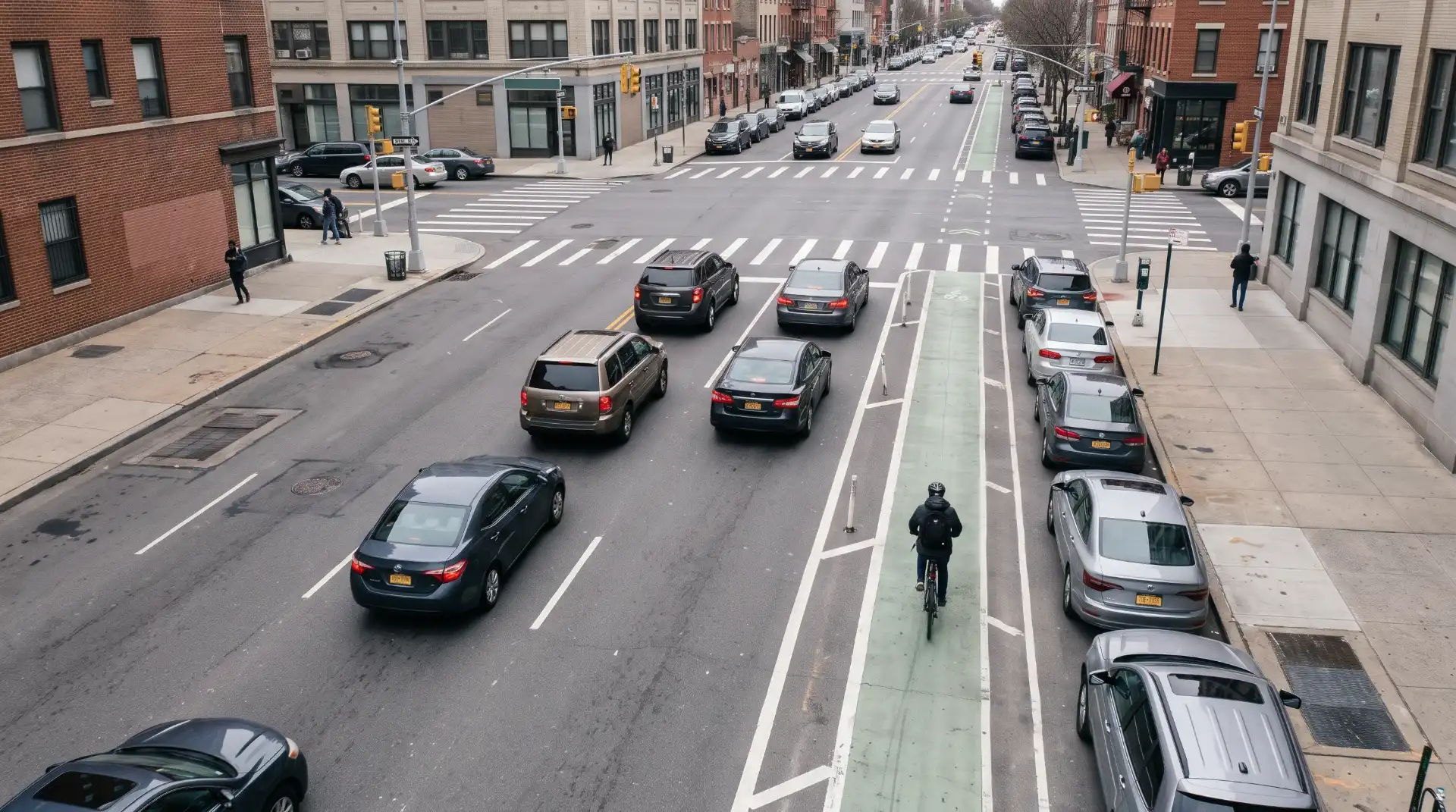
Bicycle lanes are intended to provide designated space for cyclists, but their effectiveness depends on proper planning, construction, maintenance, and placement.
A bicycle lane that is too narrow, poorly marked, obstructed by parked vehicles, or positioned dangerously close to turning traffic may create additional risks.
Some roadways contain bicycle lanes that abruptly end before an intersection, leaving cyclists to merge into faster-moving vehicle traffic. Other routes place cyclists between moving vehicles and parked cars, increasing the possibility of collisions caused by opening vehicle doors.
A painted bicycle symbol does not necessarily make a roadway safe. The surrounding traffic pattern, vehicle speeds, intersection configuration, available space, and visibility conditions all matter.
If a cyclist is injured because a dangerous bicycle facility contributed to a collision, an investigation may examine the original design plans, later modifications, maintenance records, traffic studies, and complaints concerning the location.
Dangerous Crosswalk Placement and Design
Crosswalks are important components of pedestrian safety. However, a marked crossing may still be dangerous if it is poorly positioned, difficult for drivers to see, or located where approaching vehicles have limited stopping distance.
A crosswalk near a sharp curve, a high-speed roadway, or an area with obstructed visibility may expose pedestrians to significant danger.
Some crossings are particularly difficult for older adults, children, and individuals with limited mobility because crossing distances are excessive or pedestrian signals provide insufficient time.
An investigation may examine whether the crossing location, traffic-control devices, pavement markings, lighting, and signal timing complied with applicable requirements and whether additional safety measures were reasonably necessary.
Poor Road Lighting
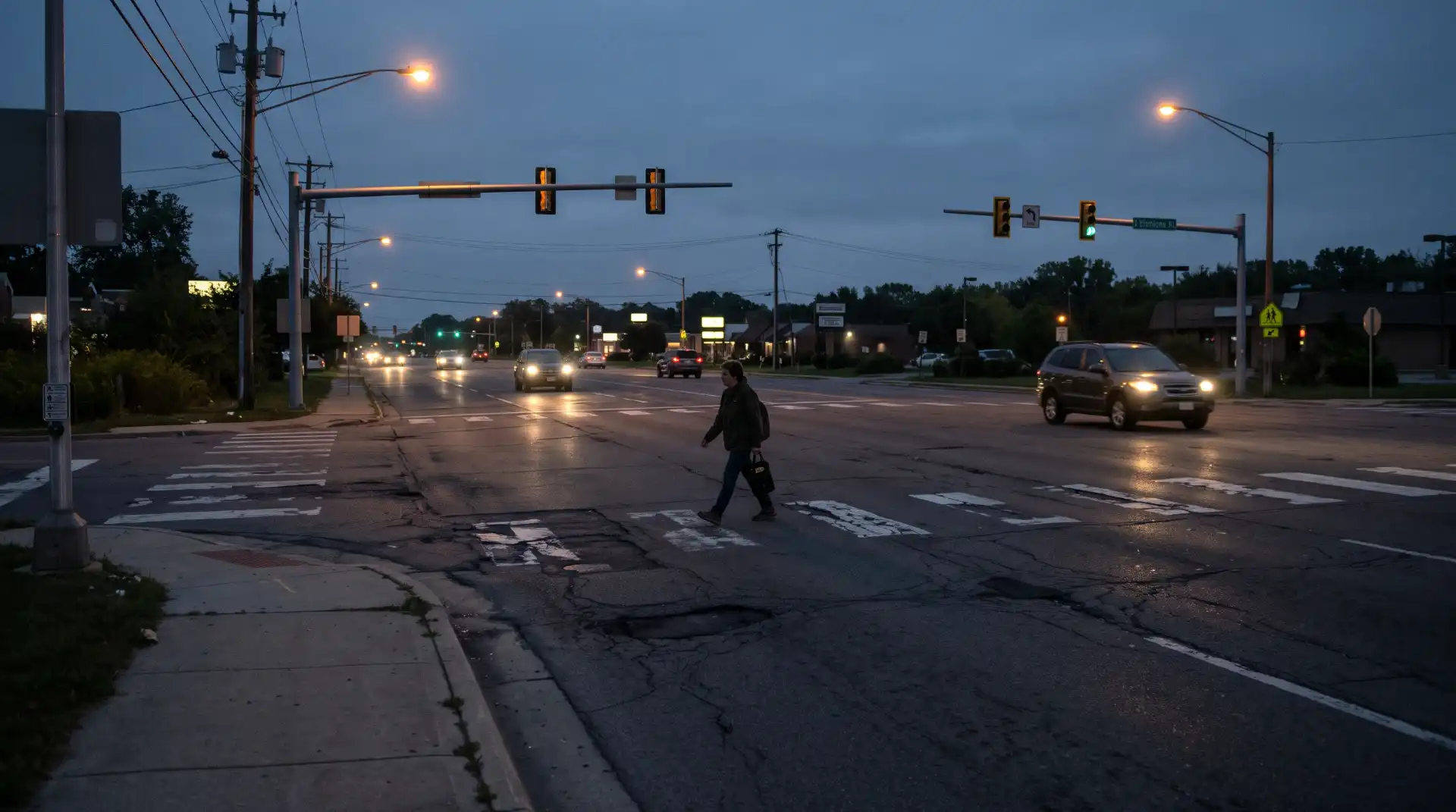
Insufficient street lighting can make pedestrians and bicyclists difficult to see, especially during early morning hours, evenings, and nighttime travel.
Lighting problems may involve damaged streetlights, poorly illuminated intersections, dark pedestrian crossings, or lighting systems that fail to illuminate important portions of the roadway.
A pedestrian wearing ordinary clothing may be difficult for an approaching motorist to identify when the surrounding environment is dark. Cyclists may also be less visible when traveling through poorly illuminated streets.
However, lighting alone does not establish liability. Investigators must determine who controlled the lighting, whether a dangerous condition existed, whether applicable maintenance obligations were breached, and whether the lighting problem contributed to the collision.
Poorly Maintained Roads and Bicycle Surfaces
Road maintenance is another important factor in pedestrian and bicycle safety.
Cracked pavement, potholes, uneven surfaces, loose gravel, damaged drainage covers, exposed utility openings, and deteriorating shoulders can create hazards for cyclists.
A cyclist who encounters a deep pothole may lose control, fall into traffic, or be thrown against a nearby vehicle. A pedestrian may trip over broken pavement or an uneven sidewalk and suffer significant injuries.
Some roadway defects are temporary, while others develop over months or years. Maintenance records, inspection reports, photographs, and prior complaints may help establish how long a dangerous condition existed.
Who Can Be Held Responsible for an Accident Caused by Unsafe Road Design?
One of the most important parts of a pedestrian or bicycle accident claim is identifying every party that may have contributed to the dangerous roadway condition.
The responsible party is not always the driver involved in the collision. Depending on the circumstances, several organizations or individuals may share responsibility.
Government Agencies Responsible for Roads
City, county, state, and federal transportation agencies may have responsibilities involving roadway construction, traffic management, inspections, maintenance, and pedestrian infrastructure.
For example, a city may control neighborhood streets and sidewalks, while a state transportation department may operate a major highway or state route.
If a government-controlled roadway contains a dangerous condition that contributes to an accident, an injured person may have a potential claim against the responsible public entity.
Possible allegations may involve inadequate maintenance, dangerous traffic-control devices, defective roadway construction, or a dangerous condition of public property.
However, government liability is not automatic. Public entities frequently have special legal protections, and some roadway design decisions may be protected by statutory immunities.
An injured person may need to establish that the public entity had a legally recognized duty, that the applicable legal requirements for liability were satisfied, and that the dangerous condition caused the injury.
Private Road Owners and Property Developers
Not every roadway is owned or maintained by a public agency.
Private developments, shopping centers, apartment communities, industrial properties, and privately controlled access roads may contain streets, sidewalks, pedestrian crossings, and parking areas used by members of the public.
A property owner or developer may have responsibility for maintaining reasonably safe conditions within areas under its control.
For example, a shopping center may have a poorly designed pedestrian crossing between its parking area and a store entrance. If vehicles routinely travel through the crossing without adequate visibility or warning measures, the property owner may face questions about the safety of the design and maintenance.
The precise duties depend on ownership, control, applicable premises liability law, and any agreements assigning maintenance responsibilities.
Road Construction and Maintenance Contractors
Construction companies and maintenance contractors may contribute to dangerous roadway conditions through negligent work.
Examples include improperly placed construction barriers, missing warning signs, unsafe temporary pedestrian routes, uncovered utility openings, poorly marked detours, and incomplete pavement repairs.
A contractor may also create hazards by leaving loose materials or equipment in areas used by cyclists and pedestrians.
Suppose a road resurfacing contractor removes pavement markings but fails to install appropriate temporary markings or warnings. A cyclist entering the affected area may become confused about the intended travel path and collide with a vehicle.
In that situation, investigators may need to review construction contracts, work schedules, traffic-control plans, inspection records, and communications between the contractor and the government agency.
Engineering and Road Design Professionals
Roadway engineers and design professionals may become relevant when an accident involves an alleged design error.
For example, an intersection may have been designed with inadequate sight distances, poorly configured turning lanes, insufficient pedestrian refuge space, or an unsafe bicycle route.
However, proving a claim against an engineering firm requires more than showing that an accident occurred at a location with an imperfect design.
An injured person may need expert evidence showing that the professional failed to meet an applicable standard of care and that the failure contributed to the accident.
The analysis may involve professional engineering standards, approved design documents, traffic studies, construction specifications, and the information available when the project was developed.
Multiple Parties May Share Responsibility
Some accidents involve more than one negligent party.
A cyclist might be struck by a speeding driver at an intersection where the bicycle lane has an unsafe configuration. The driver may have failed to yield, while another responsible party may have failed to correct a known roadway hazard.
Similarly, a pedestrian could be injured near a construction site where the contractor failed to provide a safe temporary crossing and a government agency failed to address an unsafe traffic-control arrangement.
Identifying multiple potentially responsible parties is important because it may affect insurance coverage, available compensation, and the legal strategy for pursuing a claim.
What Must You Prove to Recover Compensation?
A pedestrian or bicycle accident involving unsafe road design does not automatically create a successful personal injury claim.
Generally, an injured person must establish the legal elements of negligence or another recognized basis for liability under the applicable state law.
Establishing a Legal Duty of Care
The first issue is determining whether the defendant owed the injured person a legal duty.
Drivers generally have duties to operate their vehicles reasonably and comply with applicable traffic laws. Government agencies may have specific responsibilities concerning the maintenance or operation of public property. Private property owners and contractors may have duties based on their control of the property or their work.
The exact duty depends on the defendant’s role and the governing law.
For example, a city may have responsibility for maintaining a public sidewalk, while a utility contractor may be responsible for restoring the sidewalk after completing underground work.
An investigation must identify which party controlled the relevant area and what legal obligations applied.
Demonstrating a Dangerous Condition or Negligent Conduct
The next step is identifying the specific condition or conduct that made the roadway dangerous.
It is not enough to state that an intersection was unsafe. A claim becomes stronger when the alleged hazard can be clearly identified and supported with evidence.
Examples include:
- A crosswalk with inadequate visibility.
- A missing or defective traffic signal.
- A bicycle lane that abruptly ends in a hazardous location.
- A dangerous pothole or pavement defect.
- An obstructed pedestrian route.
- Missing or improperly maintained warning signs.
- An unsafe temporary traffic-control arrangement.
- A poorly designed intersection with inadequate sight distance.
The relevant evidence may include engineering reports, photographs, roadway plans, inspection records, and testimony from qualified experts.
Proving Causation
Causation is often one of the most disputed parts of a roadway design accident claim.
The injured person generally must establish that the defendant’s legally actionable conduct or dangerous condition was a substantial or otherwise legally sufficient cause of the accident under the applicable jurisdiction’s rules.
For example, imagine a cyclist traveling through an intersection when a vehicle turns across the bicycle’s path. The cyclist may argue that a poorly designed bicycle lane placed riders in an unexpected position and that inadequate intersection visibility contributed to the collision.
The investigation must establish how the roadway configuration affected the events and whether correcting the alleged defect would likely have prevented or reduced the risk of the accident.
A roadway defect that has no meaningful connection to the collision may not support liability.
Documenting Actual Injuries and Financial Losses
An injured person must also establish that the accident caused legally compensable harm.
Medical records, diagnostic imaging, treatment notes, rehabilitation records, employment documents, and expert opinions may help establish the nature and extent of the injuries.
Compensation may be available for medical expenses, lost earnings, future medical treatment, reduced earning capacity, pain and suffering, and other damages recognized under state law.
The amount recoverable depends on the evidence, applicable law, available insurance or public liability coverage, and any defenses raised by the defendants.
How Roadway Design Standards May Affect an Injury Claim
Roadway design standards and safety guidance can be important when evaluating whether a dangerous condition existed.
However, a violation of a technical standard does not automatically establish negligence, and compliance with a particular standard does not necessarily eliminate liability.
The applicable requirements depend on the roadway, project, responsible agency, construction date, and jurisdiction.
Federal Highway Administration Guidance
The Federal Highway Administration provides guidance concerning roadway safety, pedestrian facilities, bicycle infrastructure, and traffic-control systems.
Its Complete Streets approach recognizes that transportation systems should consider the needs of pedestrians, cyclists, motorists, and transit users rather than focusing exclusively on vehicle movement.
These principles may be relevant when examining whether a roadway adequately accommodates vulnerable road users.
The FHWA also identifies roadway design resources and recognized guidance for pedestrian and bicycle facilities.
For additional information, consult the Federal Highway Administration’s roadway design and Complete Streets resources.
Traffic Signals, Signs, and Pavement Markings
Traffic signals, signs, and pavement markings help regulate the movement of vehicles, pedestrians, and bicycles.
The Manual on Uniform Traffic Control Devices, commonly known as the MUTCD, establishes national standards for traffic-control devices on public roads and other covered roadways.
The current federal edition is the 11th Edition with Revision 1, adopted in March 2026. State adoption and implementation requirements must also be considered.
An investigation involving missing signs, confusing pavement markings, defective signals, or unsafe temporary traffic control may require an examination of the applicable MUTCD provisions and state-specific requirements.
The official publication is available through the Federal Highway Administration’s Manual on Uniform Traffic Control Devices.
State and Local Design Requirements
States and municipalities may adopt additional roadway design requirements, engineering manuals, bicycle facility guidelines, accessibility standards, and maintenance policies.
For example, a city may have specific requirements for sidewalk widths, curb ramps, pedestrian signal timing, and bicycle lane configurations.
These documents can help investigators determine whether the roadway condition departed from applicable requirements.
It is important to use the standards that applied to the specific project and time period. A design guideline published after a road was constructed may not automatically establish that the original design was negligent.
Nevertheless, later safety guidance may sometimes help experts explain known risks or identify opportunities for improvements.
What Evidence Can Help Prove an Unsafe Road Design Accident Claim?
Evidence is especially important when an accident involves a roadway defect because the dangerous condition may be repaired, modified, or removed before a lawsuit begins.
A strong investigation should document both the accident itself and the physical environment where it occurred.
Photographs and Videos of the Accident Location
Photographs can help preserve the appearance of the roadway immediately after the collision.
Images may show missing crosswalk markings, blocked sidewalks, damaged pavement, inadequate bicycle lane separation, poor lighting, construction barriers, or obstructed sightlines.
Photographs should ideally capture the entire intersection or roadway segment rather than focusing only on the exact point of impact.
It may also be useful to document the location from the perspective of an approaching driver, pedestrian, and cyclist.
If surveillance cameras, traffic cameras, or nearby business security systems recorded the accident, the footage may help reconstruct the events.
Because some recording systems automatically delete older footage, requests to preserve relevant recordings should be made promptly.
Police Reports and Witness Statements
A police report may contain information about the accident location, road conditions, vehicle movements, injuries, traffic-control devices, and statements from the people involved.
However, police reports may not fully investigate the engineering or design issues contributing to a collision.
Witness statements can also be valuable.
A nearby resident may have previously complained about the absence of a sidewalk. A cyclist may have witnessed other crashes at the same intersection. A business employee may know that a traffic signal frequently malfunctions.
Such information may help establish whether the dangerous condition existed before the accident.
Maintenance and Inspection Records
Maintenance documents may reveal whether the responsible agency knew about a dangerous condition.
Relevant records may include:
- Roadway inspection reports.
- Sidewalk repair requests.
- Maintenance schedules.
- Pothole complaints.
- Traffic signal repair records.
- Streetlight maintenance reports.
- Prior accident reports.
- Public complaints and service requests.
For example, if a city received repeated complaints about a broken pedestrian signal before an accident, those records may become important when evaluating notice and responsibility.
The legal significance of prior complaints depends on state law and the particular public entity liability requirements.
Roadway Design Plans and Engineering Documents
Original engineering plans may help establish how the roadway was intended to function.
Investigators may review intersection diagrams, construction drawings, bicycle lane plans, traffic studies, speed surveys, signal timing plans, and later modifications.
These records can help determine whether the dangerous condition existed from the beginning or developed because of later maintenance problems.
A qualified traffic engineer may also evaluate whether the roadway configuration contributed to the accident.
Expert Accident Reconstruction
In serious pedestrian and bicycle accident cases, accident reconstruction experts may examine vehicle speed, braking distance, impact location, sight distance, road geometry, lighting, and the movements of everyone involved.
A traffic engineering expert may focus on the design and operation of the roadway.
For example, an expert might evaluate whether an approaching driver had sufficient visibility to identify a pedestrian entering a crosswalk or whether the bicycle lane placed cyclists in a hazardous conflict area.
Expert opinions should be grounded in reliable evidence and applicable professional standards.
What Compensation Can Injured Pedestrians and Cyclists Recover?
When a personal injury claim succeeds, compensation may cover several categories of losses.
The available damages depend on state law, the severity of the injuries, the defendant’s responsibility, and the evidence supporting the claim.
Medical Expenses
Medical expenses are often among the largest components of a serious pedestrian or bicycle accident claim.
They may include emergency transportation, hospital treatment, surgery, diagnostic imaging, prescription medication, specialist appointments, physical therapy, and rehabilitation.
Some injuries require ongoing treatment for months or years.
For example, a cyclist who suffers a traumatic brain injury may need neurological evaluations, cognitive rehabilitation, occupational therapy, and long-term medical monitoring.
A pedestrian with a severe spinal injury may require surgery, mobility equipment, home modifications, and continuing assistance.
A claim may include qualifying past medical expenses and reasonably supported future medical costs, subject to applicable law and evidentiary requirements.
Lost Wages and Lost Income
An injured person may be unable to work while recovering.
Compensation may include income lost because of missed work, reduced hours, or an inability to perform normal job responsibilities.
For self-employed individuals, independent contractors, and business owners, proving lost income may require tax returns, business records, invoices, contracts, and other financial documentation.
The longer the recovery period, the more important it becomes to document the economic consequences of the accident.
Reduced Future Earning Capacity
Some injuries prevent people from returning to their previous occupations.
A construction worker with a permanent leg injury may no longer be able to perform physically demanding tasks. A delivery cyclist with a serious shoulder injury may be unable to return to regular work.
In these situations, a claim may include reduced future earning capacity when supported by appropriate evidence.
Economic experts, vocational specialists, and medical professionals may help evaluate the long-term effect of the injury on employment opportunities.
Pain and Suffering
Compensation may also be available for physical pain, emotional distress, and the broader effects of an injury.
A pedestrian who suffers multiple fractures may experience prolonged pain, sleep disturbances, and difficulty performing everyday activities.
A cyclist who develops chronic pain or post-traumatic stress symptoms may experience lasting changes in daily life.
The availability and calculation of non-economic damages vary by state and may be subject to statutory restrictions.
Permanent Disability and Loss of Enjoyment of Life
Serious injuries may result in permanent physical limitations.
Someone who previously enjoyed cycling, running, hiking, or participating in recreational activities may no longer be able to participate in those activities.
A permanent disability may also affect independence, family responsibilities, relationships, and everyday mobility.
These consequences may be relevant to non-economic damages where recognized by applicable law.
Wrongful Death Compensation
When a pedestrian or cyclist dies because of a dangerous roadway condition, eligible surviving family members or representatives may have a wrongful death claim.
Depending on state law, recoverable damages may include qualifying funeral expenses, lost financial support, loss of companionship, and other legally recognized losses.
Wrongful death statutes differ considerably between states, including who may bring a claim and which family members may recover compensation.
Can You Still Recover Compensation if You Were Partially at Fault?
A defendant may argue that the pedestrian or cyclist contributed to the accident.
For example, an insurance company may claim that a pedestrian crossed outside a marked crosswalk, that a cyclist failed to use a designated lane, or that the injured person was distracted.
However, partial fault does not automatically prevent recovery.
The effect of shared responsibility depends on the state’s comparative negligence or contributory negligence rules.
Comparative Negligence
Many states follow some form of comparative negligence.
Under a comparative negligence system, the injured person’s compensation may be reduced according to their assigned percentage of responsibility.
For example, suppose a cyclist suffers $200,000 in legally recoverable damages. A court determines that the cyclist was 20% responsible and the defendant was 80% responsible.
Under a pure comparative negligence system, the cyclist could potentially recover $160,000.
Under a modified comparative negligence system, recovery may be barred once the injured person’s responsibility reaches a specified threshold. The threshold varies by state.
Contributory Negligence
A small number of jurisdictions follow traditional contributory negligence rules, under which even a relatively small amount of negligence by the injured person may prevent recovery, subject to applicable exceptions.
Because these legal rules vary, an injured pedestrian or cyclist should not assume that a claim is impossible simply because an insurance company alleges shared fault.
Insurance Companies May Blame the Injured Person
Insurance adjusters may focus on pedestrian conduct, bicycle positioning, visibility, clothing, helmet use, or traffic violations when evaluating a claim.
Some of these facts may be relevant, but they do not necessarily eliminate the responsibility of another party.
For example, a cyclist’s failure to wear a helmet may be treated differently depending on the state and whether the alleged failure contributed to the injuries at issue. It does not automatically establish that the cyclist caused the collision.
Similarly, a pedestrian crossing outside a marked crosswalk may still have a potential claim if a negligent driver or another legally responsible party contributed to the accident.
The actual effect of these facts must be evaluated under the governing law.
Special Legal Challenges When Suing a Government Agency
Claims involving unsafe public roads can be more complicated than ordinary personal injury lawsuits.
Government entities may be protected by sovereign immunity or statutory limitations on liability. Although many states permit certain negligence claims against public agencies, the applicable exceptions and procedural requirements differ.
Government Claim Notice Requirements
Some states require injured individuals to submit a formal administrative claim before filing a lawsuit against a public entity.
These procedures may require the claimant to identify the accident, explain the circumstances, describe the injuries, and provide other specified information.
The filing deadline may be substantially shorter than the ordinary personal injury statute of limitations.
For example, California generally requires a claim for money or damages against a public entity to be presented within six months after the cause of action accrues for many personal injury claims, subject to statutory rules and exceptions.
Other states have different deadlines, claim forms, service requirements, and procedures.
Failing to comply with an applicable notice requirement may seriously affect the ability to pursue compensation.
Government Design Immunity
Some jurisdictions recognize legal protections for public entities concerning certain approved design decisions.
In California, for example, Government Code Section 830.6 addresses a public entity’s design immunity when specific statutory requirements are met.
The analysis may involve whether an authorized employee or body approved the plan, whether the design was reasonable under the circumstances, and whether the immunity requirements apply.
However, design immunity is not a universal defense to every roadway accident claim. The facts, statutory requirements, later changes in conditions, and applicable legal principles matter.
A roadway claim may involve a design issue, a maintenance issue, or a combination of both. These distinctions can be legally significant.
Identifying the Correct Government Agency
A road may be located within a city but controlled by a county or state transportation department.
A sidewalk may be maintained by a municipality, a private property owner, or another entity under a maintenance agreement.
Before filing a claim, it is important to identify the entity responsible for the relevant roadway segment and determine whether another party also contributed to the dangerous condition.
How Long Do You Have to File a Pedestrian or Bicycle Accident Claim?
Every state has its own statute of limitations governing personal injury lawsuits.
The deadline may depend on the type of defendant, the nature of the injury, the age of the injured person, and other circumstances.
Claims against government agencies frequently have additional administrative notice requirements.
The fact that a roadway defect remains visible does not necessarily extend the filing deadline.
Personal Injury Filing Deadlines
In many states, the standard personal injury limitation period is measured in years, but the exact period differs.
Some states allow two years, while others provide longer or shorter periods depending on the claim.
Special rules may apply when the injured person is a minor, when an injury was not immediately discovered, or when the defendant is a government entity.
Because missing a deadline can prevent recovery, injured individuals should investigate the applicable time limits as early as possible.
Why Waiting Can Damage a Claim
Even when a lawsuit deadline is not approaching immediately, delaying an investigation can make a roadway design claim harder to prove.
Government agencies may repair potholes, replace traffic signals, repaint crosswalks, or redesign dangerous intersections.
Construction companies may remove temporary signs and barriers. Businesses may overwrite surveillance footage. Witnesses may forget important details.
Early documentation can preserve evidence of the roadway’s original condition and help experts evaluate the accident accurately.
What Should You Do After a Pedestrian or Bicycle Accident Caused by Unsafe Road Design?
The steps taken immediately after an accident may affect both physical recovery and the ability to establish legal responsibility.
Seek Medical Attention Immediately
Medical treatment should be the first priority after a pedestrian or bicycle accident.
Some injuries are immediately obvious, while others develop gradually.
Head injuries, internal injuries, spinal trauma, and soft tissue damage may require prompt medical evaluation even when symptoms initially appear manageable.
Following medical recommendations also creates records documenting the injuries and their relationship to the accident.
Report the Accident
If a motor vehicle is involved or someone has suffered an injury, contact law enforcement as appropriate.
An official report may document the location, parties involved, road conditions, witness information, and initial observations.
If a dangerous roadway condition exists independently of the accident, consider reporting it to the agency responsible for the location.
However, do not assume that reporting a defect automatically satisfies any formal legal claim notice requirement.
Photograph the Roadway
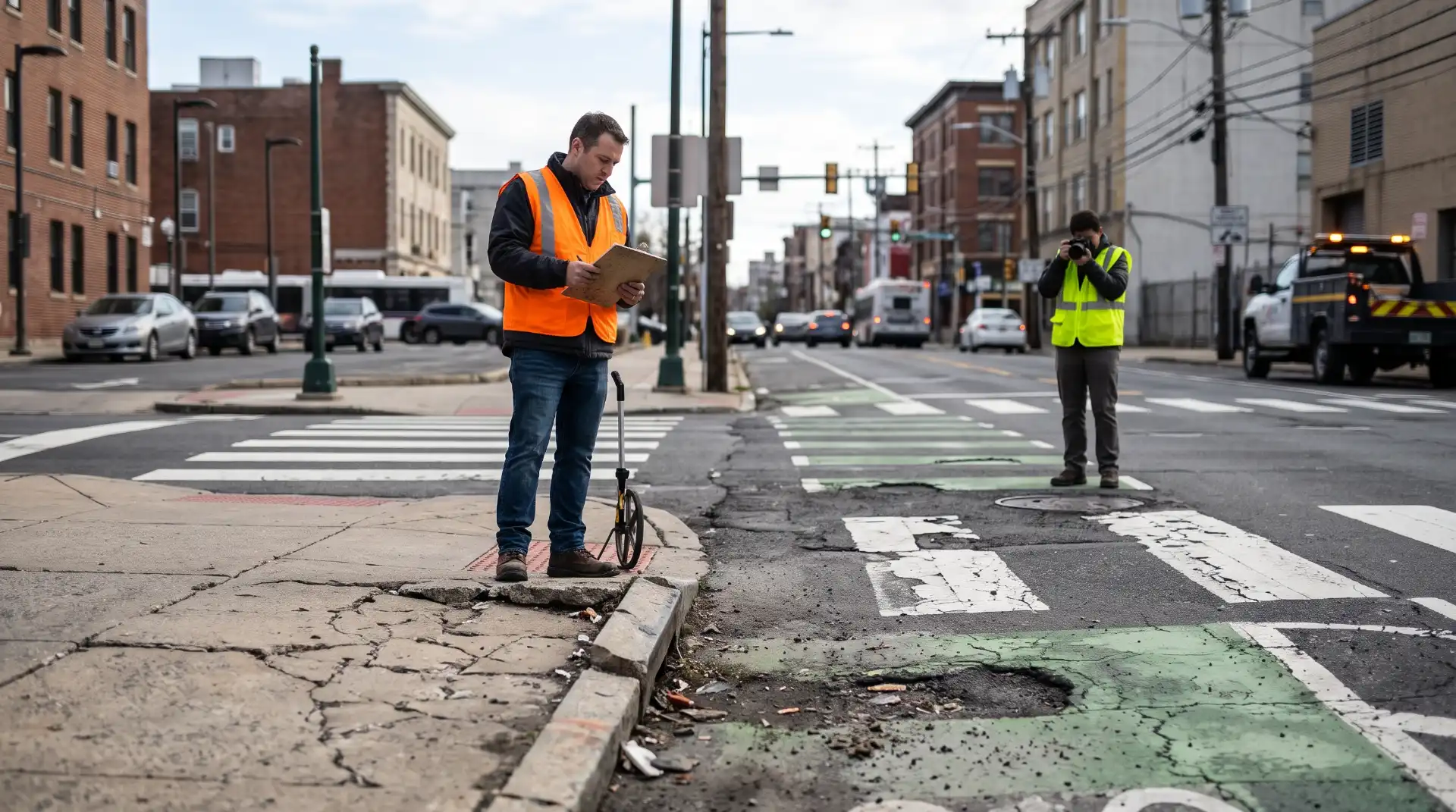
If it is safe and practical, preserve photographs of the accident scene.
Document the roadway from several angles, including the approach to the intersection, pedestrian crossing areas, bicycle lanes, signs, signals, lighting, pavement defects, and surrounding obstructions.
Photographs should capture enough surrounding detail to show how the roadway functioned before the collision.
If the injured person cannot take photographs, witnesses or family members may be able to help.
Preserve Physical and Digital Evidence
Keep damaged bicycles, helmets, clothing, vehicle parts, and other relevant physical evidence when possible.
Do not repair or discard important items before their condition has been documented.
Preserve relevant messages, photographs, GPS information, cycling computer data, dashcam recordings, and other digital evidence.
These materials may help establish the route, timing, location, and circumstances of the accident.
Avoid Giving Detailed Recorded Statements Without Understanding Your Rights
Insurance companies may contact injured individuals shortly after an accident.
A statement given before the facts are fully understood may be incomplete or inaccurate.
Be careful about speculating on the cause of the accident, accepting responsibility, or agreeing to a settlement before the full extent of the injuries and potential liability issues have been evaluated.
Obtain Legal Guidance Early
An attorney experienced in pedestrian and bicycle accident litigation may help identify responsible parties, evaluate government claim requirements, preserve evidence, and coordinate expert investigations.
This can be especially important when the accident involves a public roadway, a construction project, or multiple potentially responsible parties.
Practical Examples of Unsafe Road Design Accident Claims
Understanding how these cases may develop can help explain why investigating the roadway itself is important.
Example 1: Pedestrian Struck at an Intersection With Obstructed Visibility
A pedestrian is crossing a city street at an intersection when a driver turns into the crossing area and strikes the pedestrian.
Investigators discover that permanent landscaping and roadside equipment obstruct the driver’s view of the crosswalk.
The pedestrian may have a claim against the driver. Depending on the facts, the investigation may also examine whether the responsible public entity negligently maintained the area or failed to address a legally actionable dangerous condition.
Important evidence may include photographs, maintenance records, prior complaints, intersection plans, and expert visibility analysis.
Example 2: Cyclist Injured Where a Bicycle Lane Abruptly Ends
A cyclist travels along a designated bicycle route that suddenly ends near a busy intersection.
The rider must merge into moving traffic and is struck by a vehicle.
The cyclist may have a claim against the driver if the driver acted negligently. The cyclist may also investigate whether the roadway design or operation contributed to the dangerous merging condition.
Relevant evidence may include bicycle lane plans, roadway markings, traffic volumes, intersection geometry, and previous safety studies.
Example 3: Pedestrian Falls on a Broken Sidewalk
An individual walks along a public sidewalk and trips over a raised section of concrete, suffering a serious injury.
The sidewalk has reportedly been damaged for an extended period, and nearby residents previously submitted repair requests.
The potential claim may involve the entity responsible for sidewalk maintenance or another party responsible for creating the defect.
Important questions include who controlled the sidewalk, whether the condition met the legal definition of a dangerous condition, whether the defendant had the required notice, and whether any statutory defenses apply.
Example 4: Cyclist Crashes Because of Unsafe Construction Detours
A road construction project closes a bicycle lane without providing a clearly marked alternative route.
A cyclist follows the roadway and encounters an unexpected barrier, causing a fall into nearby traffic.
The investigation may examine the contractor’s traffic-control plan, temporary signs, construction agreements, inspection reports, and the responsibilities of the public agency overseeing the project.
Depending on the circumstances, liability may extend beyond the driver of a vehicle involved in the collision.
These examples are illustrative. Actual liability depends on the facts, applicable law, and available evidence.
Why Accident Reconstruction and Roadway Engineering Experts Matter
Unsafe road design claims frequently involve technical questions that cannot be answered through photographs or witness statements alone.
Accident reconstruction experts may evaluate vehicle movements, speed, braking, impact location, and visibility.
Traffic engineers may examine roadway geometry, pedestrian crossing placement, bicycle lane configuration, traffic signal timing, and applicable design guidance.
Human factors experts may evaluate how road users perceive and respond to the roadway environment.
In some cases, medical experts may also be needed to explain the nature of the injuries and their long-term effects.
For example, a reconstruction expert may determine that a driver had insufficient time to react because an intersection provided limited sight distance. A traffic engineer may then evaluate whether the intersection’s configuration met the applicable standards and whether a different design could have reduced the risk.
Expert testimony can be especially valuable when a defendant argues that the collision was unavoidable or entirely caused by the injured person’s conduct.
However, expert opinions must be supported by reliable evidence and must address the relevant legal questions.
How Much Is a Pedestrian or Bicycle Accident Claim Worth?
There is no universal settlement amount for an accident caused by unsafe road design.
Two individuals injured at the same intersection may have very different claims because their injuries, treatment requirements, employment situations, and legal circumstances differ.
A person with temporary soft tissue injuries may have substantially different damages from someone who suffers a permanent spinal injury.
Several factors can influence the potential value of a claim.
The severity of the injuries is important because serious injuries often involve greater medical expenses, longer recovery periods, and more significant effects on everyday life.
The strength of the liability evidence also matters. A claim supported by photographs, prior complaints, engineering records, expert opinions, and reliable witness statements may be easier to evaluate than one based on uncertain circumstances.
The number of responsible parties and available insurance coverage may also affect the practical ability to recover compensation.
Comparative negligence rules can reduce or restrict recovery depending on the injured person’s share of responsibility.
Claims involving government agencies may also be subject to statutory damage limitations or other restrictions in certain jurisdictions.
An injured person should be cautious about online settlement calculators or promises of a particular compensation amount. A reliable evaluation requires an examination of the actual injuries, liability evidence, applicable state law, and available coverage.
Frequently Asked Questions About Unsafe Road Design Accidents
Can I sue a city if I am injured because of a dangerous sidewalk?
Possibly. A city or another public entity may be liable when the applicable legal requirements for a dangerous condition of public property are satisfied. The claim may depend on ownership, control, notice, causation, statutory immunity, and compliance with special government claim procedures.
Can a cyclist sue if a poorly designed bicycle lane causes an accident?
A cyclist may have a potential claim if a legally responsible party negligently designed, constructed, maintained, or operated the roadway and the condition contributed to the collision. The specific claim depends on the applicable law and the evidence.
What if a driver and the government agency both contributed to the accident?
More than one party may share responsibility. An injured person may be able to pursue claims against multiple defendants, subject to the rules governing comparative fault, government liability, and applicable procedural requirements.
Does an unsafe road design have to violate a federal standard?
Not necessarily. Liability may depend on state or local legal duties, applicable engineering standards, the condition of the roadway, and the circumstances surrounding the accident. A federal standard may be relevant, but it is not the only possible source of evidence.
Can I recover compensation if there was no bicycle lane?
The absence of a bicycle lane does not automatically establish negligence. However, the overall roadway configuration, traffic conditions, applicable legal requirements, and responsibility of the parties may be relevant to a claim.
What if the road was repaired after my accident?
A repair does not necessarily eliminate a potential claim. Earlier photographs, witness statements, maintenance records, inspection reports, and other evidence may help establish the original condition.
Can a pedestrian recover compensation if they crossed outside a marked crosswalk?
Possibly. The effect of crossing outside a marked crosswalk depends on the state’s pedestrian laws and comparative or contributory negligence rules. It does not automatically establish that every other party was free from responsibility.
How long does an unsafe roadway accident claim take?
The timeline varies. Claims involving multiple defendants, government agencies, serious injuries, or engineering experts may take longer to investigate and resolve than straightforward vehicle accident claims. Some cases settle through negotiations, while others require litigation.
Should I hire a personal injury attorney for a dangerous roadway accident?
Legal representation may be particularly valuable when the case involves government liability, complex roadway engineering, multiple defendants, substantial injuries, or disputed fault. An attorney familiar with the relevant state’s laws can evaluate deadlines and help preserve important evidence.
Conclusion: Unsafe Road Design May Create a Valid Personal Injury Claim
Pedestrian and bicycle accidents are not always caused by careless drivers alone. In some situations, dangerous roadway design, inadequate infrastructure, defective traffic-control systems, or negligent maintenance may contribute to serious collisions.
Missing sidewalks, poorly positioned crosswalks, unsafe bicycle lanes, obstructed intersections, inadequate lighting, and damaged pavement can create risks for people who depend on safe transportation infrastructure.
When these conditions contribute to an accident, injured individuals may have legal options beyond pursuing a claim against the driver. Depending on the circumstances, a responsible government agency, property owner, contractor, engineering professional, or another party may also face potential liability.
However, these cases require careful investigation. The injured person generally must establish the applicable legal duty, identify the dangerous condition or negligent conduct, demonstrate causation, and document the resulting damages. Claims against government agencies may involve special notice requirements, statutory immunities, and shorter deadlines.
Preserving evidence is particularly important because roadway conditions can change quickly after an accident. Photographs, surveillance footage, witness statements, maintenance records, engineering plans, and expert analysis may all help establish what happened.
If you have suffered injuries in a pedestrian or bicycle accident involving an unsafe roadway, consider seeking medical attention and obtaining advice from a qualified personal injury attorney in your state. An early investigation may help identify responsible parties, protect important evidence, and clarify the legal options available to pursue compensation.
Legal Disclaimer: This article provides general educational information about pedestrian and bicycle accident claims in the United States. It is not legal advice and does not create an attorney-client relationship. Laws, government claim procedures, liability standards, and filing deadlines vary by state. Consult a licensed attorney familiar with the law in your jurisdiction about your particular circumstances.